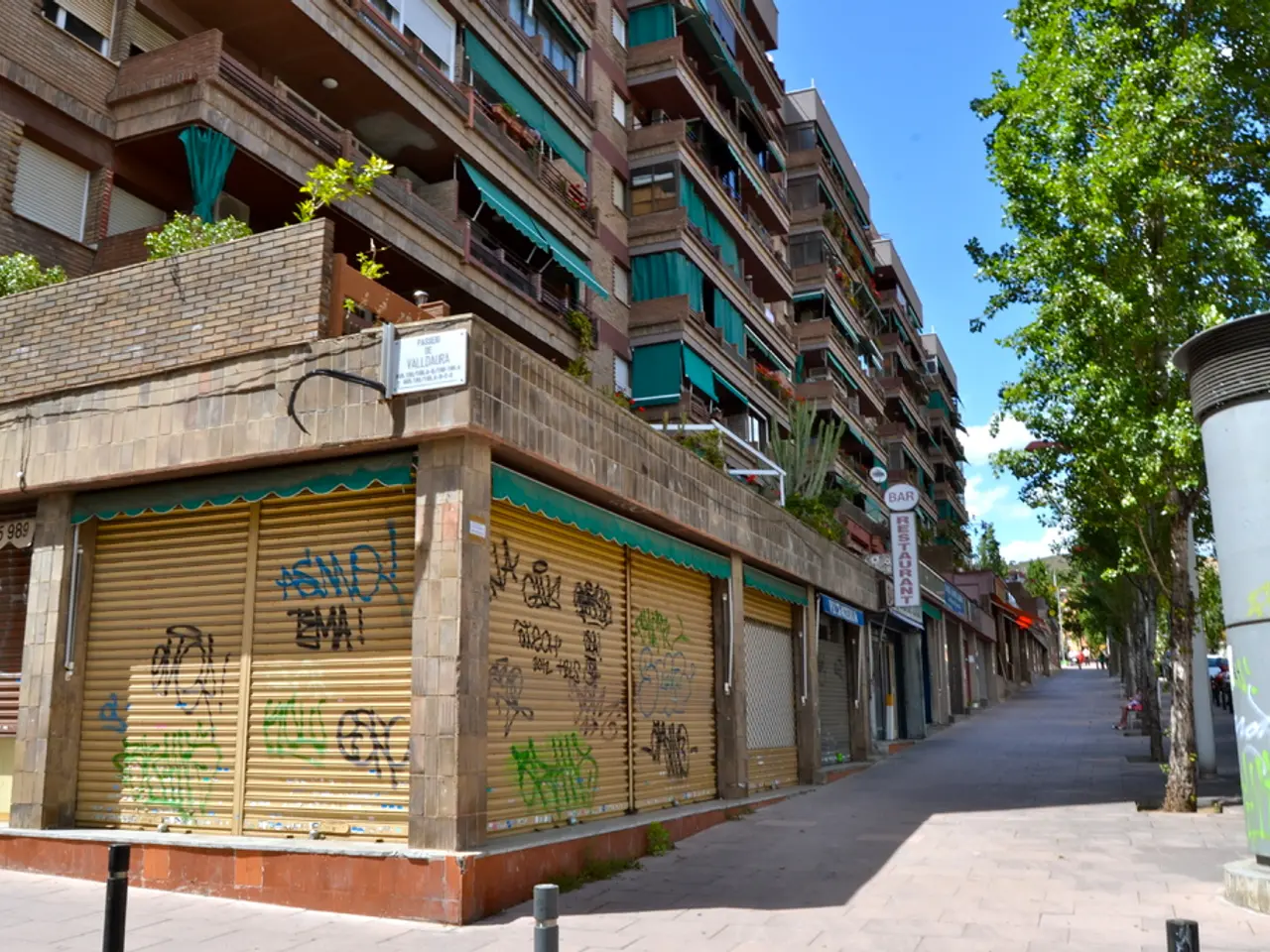
Conservationists aim to preserve Berlin's shopping mall
In a bid to breathe new life into Berlin's struggling shopping centres, the Green Party has put forward a series of innovative proposals. Bettina Jarasch, the faction leader, believes that these ideas could create a "win-win situation", attracting more customers while contributing to the creation of a city with short distances.
Jarasch suggests transforming vacant or underused shopping centre spaces into community hubs, such as coworking spaces, cultural centres, or social enterprises promoting local arts and crafts. She also advocates for introducing multifunctional public spaces that support activities like urban gardening, educational workshops, or environmental awareness programmes.
The Green Party's proposals extend to promoting sustainable uses, such as urban farming, local start-up incubators, or nonprofit services, inside these shopping centres. This approach aims to reduce vacancy rates while aligning with ecological and social goals. Jarasch also urges the districts and the state of Berlin to consider shopping centres when looking for space for citizen services, advice centres, or neighbourhood libraries.
However, it's important to note that the success of these ideas is dependent on factors such as the height of rents and the ownership structure of the respective shopping centre. The trade association Berlin-Brandenburg supports the ideas of the Greens, but notes that many of these ideas have long been implemented.
The Green Party's position paper also demands the use of space by public administration in shopping centres. This could potentially be seen in the "Wilma Shoppen" shopping centre on Wilmersdorfer Straße (Charlottenburg), which houses an external branch of the citizen's office on its top floor.
The Senate of Berlin has presented a ten-point plan for the further development of shopping centres, focusing on simplified funding opportunities to combat vacancy. However, specific details on current proposals by the Green Party in Berlin regarding non-consumption uses for struggling shopping centres are not yet available in the public domain.
It's worth mentioning that Berlin has approximately 70 shopping centres, many of which are currently grappling with empty stores and low demand. The Green Party believes that a "clever mix of uses" in shopping centres can make them lively places for the neighbourhood and local area. Julian Schwarzen, the Green spokesman for urban development, emphasises that there is no one concept that works for all locations.
The Green Party's proposals for Berlin's shopping centres reflect their usual urban and social policy priorities, focusing on promoting community engagement, sustainability, and mixed-use development. For precise details on current proposals by the Green Party in Berlin, specialized sources or recent policy papers would need to be consulted.
The Green Party's proposals aim to see vacant shopping centre spaces transformed into community hubs, hosting coworking spaces, cultural centres, or shops promoting local arts and crafts - placing an emphasis on home-and-garden-related products and services as part of the broader lifestyle scene. In line with these ideas, multifunctional public spaces are also suggested, supporting activities like urban gardening and environmental awareness programmes within these shopping centres, thereby fostering a sustainable and integrated "win-win" lifestyle.